
Time: 13:30, 10 July 2025
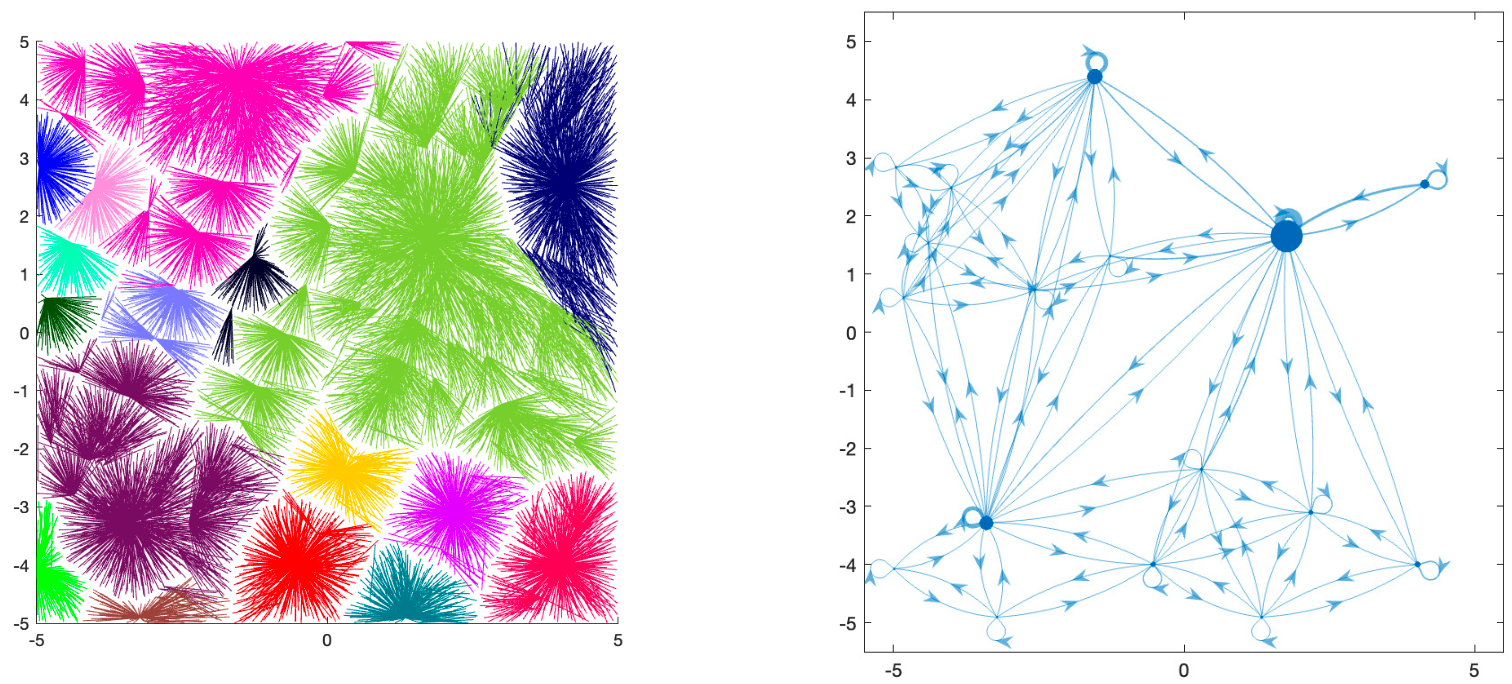
We often conceptualise the optimisation function as being on the continuous 1D line. Here, the bottom of “dip”s local are local minima, and the “peak”s are saddle-points between them. We can see the landscape of the underlying function clearly and it is easy to see its structure and features. In two dimensions we likewise can visualise a contour-plot/3D-plot in a similar way. But how do we convey fundamental structures of optimisation landscapes when the function has many more than two inputs? Or where the search space is over bit-strings, or permutations, rather than continuous values? Work on using trees/networks to characterise optimisation landscapes has progressed for some time now, with the initial work on barrier trees in the late 1990s, and the first work on local optima networks in the late 2000s. These landscape models were developed principally to understand the landscapes experienced by local search heuristics, to help analyse and explain the behaviours of optimisation algorithm that utilised them. Both barrier trees and local optima networks define a landscape using a tuple of a search domain, a neighbourhood function, a fitness (or cost) function and a local search method that utilises the first three elements. In this talk we will introduce the main ideas of these two approaches, discuss how they work and their limitations, illustrate the kinds of observations that can be made with them, and give some examples of recent developments in this area.
Location/Room: Robert Recorde Room, Computational Foundry (102)
Speaker:
- Prof. Jonathan Fieldsend
Jonathan Fieldsend is Professor of Computational Intelligence in the Department of Computer Science at the University of Exeter. His work primarily sits at the interface of optimisation and machine learning, where he develops methods and algorithms for the optimisation of industrial problems, typically with multiple objectives. Jonathan is currently an Associate Editor of the ACM Transactions on Evolutionary Learning and Optimization, is Program Co-Chair of the 2025 edition of the ACM Conference on Foundations of Genetic Algorithms (FOGA), and will be General Co-Chair of the Evolutionary Multi-criterion Optimisation (EMO) 2027 international conference.
Contact Information: Dr Alma Rahat (a.a.m.rahat@swansea.ac.uk)
