
Time: 14:00-15:00, 30/07/2025
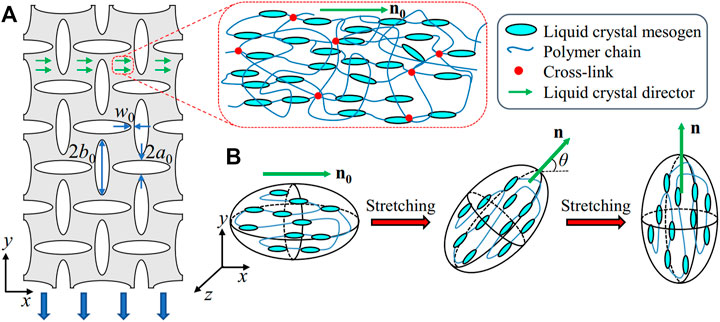
Combining the self-organisation of liquid crystals (LCs) with the flexibility of elastomers results in a special class of stimuli-responsive solid materials called liquid crystal elastomers (LCEs). These materials deform in response to changes in the LC orientation driven by temperature variation, electric, magnetic, or optical fields, and their LC alignment changes when mechanical loads are applied. This makes LCEs a top choice for bioinspired devices and engineering designs.
In this study, we devise a mathematical model for nonlinear viscoelastic deformation of LCEs that can capture the unique mechanical behaviour shown by LCEs. The model demonstrates that, depending on whether the order parameter remains constant or not, the classical phenomenon of semi-soft elasticity whereby the nematic director rotates forming a pattern of shear stripes may or may not be observed. Experimentally, measuring the order parameter during shear striping is challenging, and the assumption that this parameter remains the same as during the deformation before and after this instability occurs is usually made. The model shows that change in the order parameter during deformation may leads to necking under certain condition. Furthermore, viscoelastic model developed also takes account the viscous effect due to the rotation of LC mesogens.
Location: Computational Foundry (Bay Campus), Room 102
Speaker:
- Rabin Poudel
Rabin Poudel is currently a PhD student in the School of Mathematics at Cardiff University. His PhD Research is on mathematical modelling and numerical simulation of the mechanical behaviour of liquid crystal elastomers. His Research interest lies in solid mechanics, material modelling and finite element simulation. He obtained his MSc degree in Civil Engineering from RWTH University with a specialization in advanced computation methods. For the master’s thesis, under the supervision of Dr. Vu Khiem, he developed finite element formulation for coupled thermoelastic behaviour to simulate strain-induced crystallization in elastomers. Later, he worked as a Research Assistant in the Department of Continuum Mechanics at RWTH University itself in Soft Matter Group under supervision of Dr. Vu Khiem, before moving to Cardiff University for my PhD.
Contact Information: Dr Mokarram Hossain