
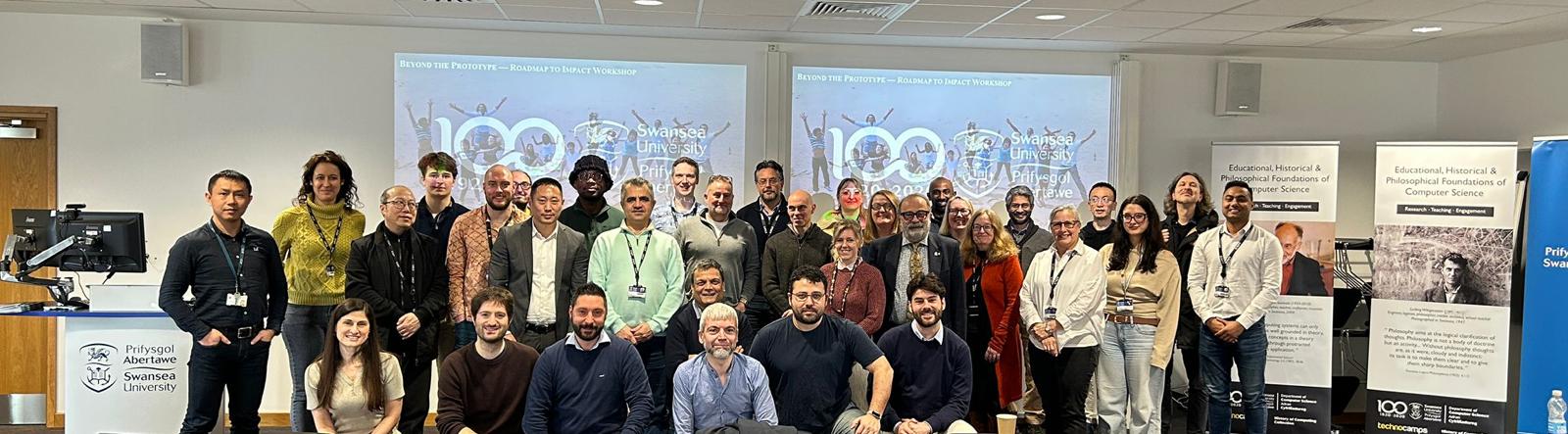
Date: 11th February 2026
Location: Computational Foundy/Swansea University
Contact Information: Daniele Cafolla <daniele.cafolla@swansea.ac.uk>
Overview of Event:
“Beyond the Prototype: Building the Roadmap to Impact” was a one‑day impact workshop held at Swansea University, bringing together clinicians, researchers, industry partners, and technologists to explore how an AI‑enabled, wearable, multi‑parameter monitoring platform can be translated from laboratory prototype to real‑world clinical use. The event focused in particular on chronic disease management and heart failure, using this concrete application to ground broader discussions about digital health, monitoring, and patient‑centred innovation.
Hosted within the vibrant environment of the Computational Foundry and supported by the Research Wales Innovation Fund (RWIF) – Swansea, the workshop was designed not as a traditional conference, but as a collaborative “impact café”. The aim was to create a space where diverse stakeholders could openly discuss manufacturability, clinical pathways, validation, ethics, feasibility, and the practical challenges of adoption. Participants were encouraged to move beyond presentations and engage in structured conversations, co‑design activities, and informal exchanges throughout the day.
The programme combined keynote talks, clinical and technical flash talks, and demo/stand sessions showing the current state of the wearable monitoring platform and related technologies. Academic speakers presented advances in AI, signal processing, modelling, and human–machine interfaces, while clinicians discussed unmet needs in chronic disease management and the reality of implementing new monitoring tools in care pathways. These insights were then picked up in interactive sessions where participants worked together to map potential use cases, pilot studies, and routes to scale‑up and evaluation.
A distinctive feature of the event was the strong presence of industry and translational partners. AEBiosystem contributed expertise in certified biomedical devices for continuous monitoring and preventive diagnosis, reflecting their collaboration in developing the product and co‑filing a patent together with Swansea University.
Brighter Signals brought in their perspective on high‑depth tactile perception technology and its potential for rich, touch‑based human–technology interaction.
The Textile Robotics Lab at the BioRobotics Institute, Scuola Superiore Sant’Anna added a complementary view on textile robotics and soft wearable systems, highlighting how advanced materials and design can be integrated with sensing and AI.
Throughout the workshop, the Impact Exchange Café format encouraged participants to circulate across themed tables, each addressing a different aspect of the translational journey: from technical robustness, data quality, and interpretability to regulatory pathways, clinical trial design, economic value, and user experience. This format helped surface both opportunities and barriers, and generated a set of practical ideas for future collaborative projects, feasibility studies, and joint funding applications at regional, UK, and European levels.
The event also served to celebrate and consolidate progress made under the RWIF‑supported fellowship, including the joint patent filed by AEBiosystem and Swansea University on the underlying monitoring technology. At the same time, it emphasised that this is only the beginning of a longer‑term endeavour. By connecting expertise from engineering, computer science, clinical practice, and industry, the workshop laid the groundwork for a community committed to co‑developing, testing, and deploying technologies that can make a tangible difference in the lives of patients living with chronic conditions.
Set in Swansea’s coastal campus and the inspiring setting of the Computational Foundry, the workshop fostered a culture of openness, curiosity, and collaboration. Participants left with new contacts, clearer ideas about the paths from prototype to practice, and a shared ambition to reconvene, expand the network.
Special Thanks to: Nader Al Khatib and Giovanni Mastrangelo for their vital help during the event
Keynotes: Marco Ceccarelli, Giuseppe Zuccalà, Jo Davies, Christopher George, and Andrea Tales
clinical / technology flash‑talk contributors: Rhys Bowley, Nicholas Micallef, Mingfeng Wang, Xianghua Xie, Livio Robaldo, Gibin Powathil, and Carlo Tiseo
A central strength of the “Beyond the Prototype: Building the Roadmap to Impact” workshop was the diversity and quality of its speakers and business partners, who together illustrated the full pathway from concept to clinical and commercial impact. The programme combined keynote presentations, clinical and technical flash talks, and contributions from companies and labs working directly on the enabling technologies behind the AI‑enabled, wearable, multi‑parameter monitoring platform. The keynote speakers provided strategic and scientific framing for the day.
If you are interested in joining the next steps of this work (collaborations on monitoring, AI in care pathways, validation, feasibility/implementation studies, or new project ideas), please get in touch.


